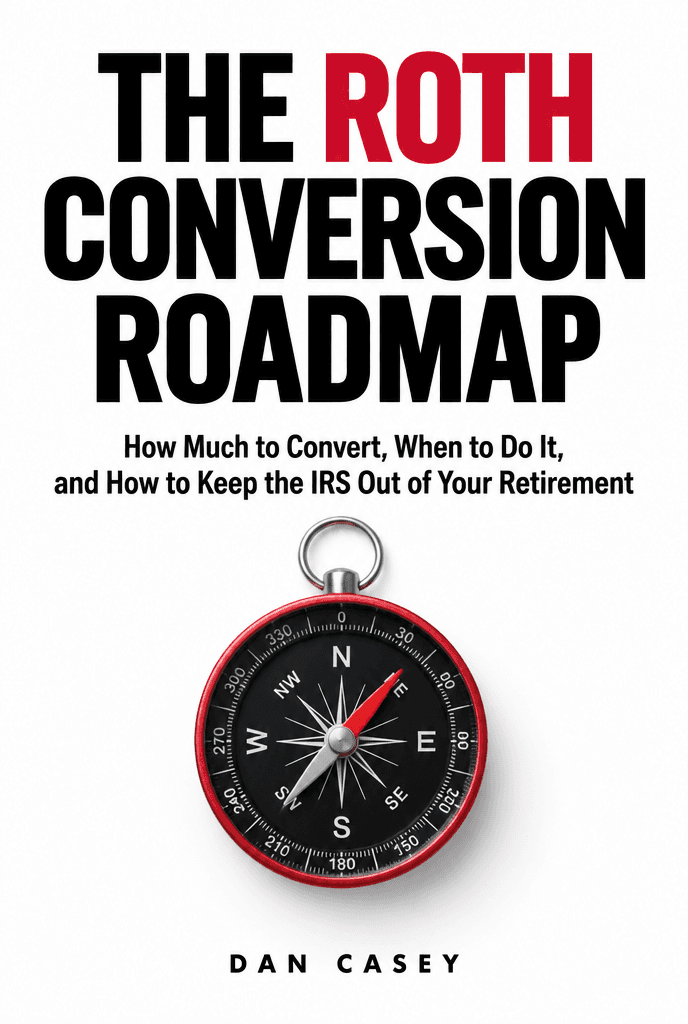
A new book by Dan Casey
That million isn’t
all yours.Your IRA has a silent partner.
The IRS has been a partner in that account since your first contribution, and they have been very patient. The Roth Conversion Roadmap shows you how much to convert, when to do it, and how to keep the IRS out of the rest of your retirement.
The book is free. Just $9.95 shipping and handling, and it’s at your door in about a week.
The arithmetic nobody ran
The $381,000 nobody told them about
Here is the part nobody mentioned at the retirement party. A traditional IRA is essentially an IOU to the IRS — a growing, compounding tax liability. Watch what happens to one million dollars when you do absolutely nothing wrong.
Age 65
$0 million
in a traditional IRA. You don’t touch it. It grows at 6% a year.
Age 73
$0.0 million
That is what the account is worth when the required withdrawals begin.
The first year
$0
Roughly what the IRS requires you to withdraw. It climbs every year after that, because the percentage goes up as you age.
Ages 73 to 90
$0.0 million
The required withdrawals add up to about this much. Every dollar of it is ordinary income.
The federal tax alone
$0
At 22% federal tax — and most people in this situation are paying at least that — this is the bill on one account.
Still in the account at 90
$0.0 million
The family’s total bill on that one account
past $0
When that money passes to your kids under current law, they generally have to empty the account within ten years, on top of their own income, often in their highest earning years. Either you pay the tax on that money or they do.
“Now, your numbers are different. Maybe you have more, maybe you have less, but the shape is the same for everyone.”
Chapter ten, in one paragraph
There is a window.
Between the day you retire and the day the required withdrawals start, there is a stretch of years — sometimes five, sometimes ten — where your income is the lowest it will ever be. No paycheck. Withdrawals aren’t required yet. Maybe you haven’t even started Social Security.
Those are the lowest tax brackets you will ever be in for the rest of your life. That’s the window.
Inside it you can move money out of the taxable account on purpose, in amounts you choose, at brackets you choose, into a place where it is never taxed again. Filling the lower brackets on purpose instead of skipping them. The $381,000 in that example doesn’t disappear — but a meaningful piece of it can.
But the window closes. Every year you wait it’s a year shorter, and at 73 it’s gone.
This is not a book about doing something drastic. It’s a book about baby steps — paying some of that tax now, on purpose, in amounts small enough that you never jump a bracket.
What’s inside
Fourteen chapters. No jargon, no filler.
It opens with the client story behind that $381,000 and ends with your own next step. Every chapter starts with a number or a question and closes with what it means for you. Where a term has to appear — RMD, IRMAA, provisional income, the ten-year rule — it gets one plain sentence the first time, and then we move on.
Roughly 130 pages. Written to be read in an evening, and kept on the shelf for the year you decide to act.
- 01
Your IRA Has a Silent Partner
Tax-deferred was never tax-free. Congress sets the rate later.
- 02
Two Doors Into the Roth
Contributions need a paycheck. Conversions never do, and there is no limit.
- 03
The Five-Year Rule Is Actually Two Rules
Both of them, in plain English, with the clocks drawn out.
- 04
The Government’s Withdrawal Schedule
What an RMD is, when it starts at 73 or 75, and why it climbs every year.
- 05
How Your RMD Raises Two Other Bills
The tax on your Social Security and the surcharge on your Medicare.
- 06
Same Money, Same House, Higher Bracket
The widow’s penalty, side by side, in 2026 numbers.
- 07
The Inheritance That Comes With a Bill
The ten-year rule, and why your kids inherit in their worst tax years.
- 08
When Does Converting Pay Off?
Honest breakeven math, and the four times you should not convert.
- 09
Three Buckets
Tax-deferred, tax-free, taxable — and why one bucket leaves you no lever.
- 10
Fill the Bracket
The method: this year’s income, the bracket line, the gap, the guardrails.
- 11
Convert Smarter
Down markets, timing inside the year, and the withholding trap.
- 12
A Ten-Year Roadmap, Year by Year
One couple, ten years, every number on the table.
- 13
Twelve Ways People Get This Wrong
The mistakes I see in my office most weeks.
- 14
Run Your Numbers
Your next step, and what the free review actually gives you.
Plus an appendix of the 2026 numbers at a glance — brackets, standard deductions, the IRMAA table, RMD ages, Social Security thresholds — and a twenty-term glossary. These figures change every year, and the book says so on every page that uses one.
Who this is for
Written for one kind of reader.
If all three of these describe you, this book was written for your situation specifically. If you are already past 73, chapter seven is still yours: the decision stops being about your tax rate and starts being about your children’s.
01
You’re 55 or older
Close enough to retirement that the decisions in this book are live ones, with time left to make them in small steps instead of one painful year.
02
You have $300,000 or more saved
A $300,000 IRA at 60 becomes $500,000-plus at 73. That is enough to make 85% of your Social Security taxable. This is not a wealthy-person problem.
03
You still have the window
Retired, or close to it, and not yet taking required withdrawals. That gap is where every strategy in the book lives — and it gets one year shorter each year.
Your copy
Send me the free book.
Tell us where to mail it. The book is free; shipping and handling is $9.95, paid on the next screen through Stripe.
- 1
It ships within a few days
A real 110-page paperback, mailed to the address you give us for $9.95 shipping and handling. US addresses only.
- 2
Run your numbers while you wait
The calculator on this site shows your bracket headroom and your projected RMD in about two minutes.
- 3
No pressure, ever
If you’d like a set of eyes on your own accounts, the review is free and you can book it yourself. If you’d rather just read, read.
While you wait for the mail
Run your own numbers in two minutes.
The free calculator on this site shows how much room you have left in your bracket this year, what your required withdrawal looks like at 73 or 75, and what the IRS is currently on track to collect. No login, nothing saved.
Estimates only, built on 2026 federal figures. Education, not advice.